

Ostrava in the 19th Century
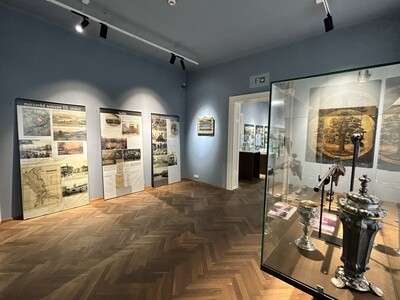
Lithographies by Ernst Wilhelm Knippel (panel 1, pict. 1) and Jakob Alt (panel 1, pict. 2, 3) from the second half of the 19th century show how Moravian Ostrava looked during that time. The city centre is depicted on the ground plan of this imperial imprint from 1833.
This picture of events taking place in the city dates back to 1873 and is the product of one of the several professional photo galleries in operation at that time.
The chain-linked bridge spanning the river Ostravice collapsed on September 15, 1886 (panel 1, pict. 5). It had linked the Moravian and Silesian sides of the river since 1851 and was the architectural pride of Ostrava. The Austro-Hungarian emperor himself, Franz Joseph I, passed over this bridge during his visit in 1880.
Another picture shows the Main Square looking towards Main Street in the 1880s, with the Marian column constructed as a protection against the plague in 1702 (panel 1, pict. 7).
A new, smaller square, today called Jirásek Square, went up not far from the Mail Square around 1900 and dubbed at that time “Poultry Square”. The original name was Franz Joseph Square. The old medieval town bordered the northern part of the town, where the suburb of Přívoz is now located (panel 1, pict. 8).
This unique map of Ostrava illustrates the flooding that occurred in the Přívoz and Vítkovice districts of Moravian Ostrava after the Ostravice and Lučina rivers burst their banks on August 5, 1880 (panel 1, pict. 6).
ASSOCIATIONS AND GUILDS
Many civic associations came into being in Ostrava after 1860. There were more than fifty associations and guilds at the turn of the 19th and 20th centuries, differing in interest and national makeup. The significance for the citizens of Ostrava was the awakening of a national consciousness of an educational, cultural and social character. Among the more important associations was the ”Občanská beseda” or Civic Forum, which stocked a library of nearly 1,000 volumes.
These pictures show members of the Reading guild (panel 2, pict. 1), the Voluntary firemen (panel 2, pict. 2, 3), the Lumir Chorus (panel 2, pict. 4), and the Dobromila women’s charity club (panel 2, pict. 5). This interesting photo shows the Firemen’s Guild during firefighting training on the Mail Square in 1883 (panel 2, pict. 3).
The Marksmen’s Guild was among the most significant and active ones in Moravian Ostrava. Provincial shooting was organized under the auspices of the guild, which staged the largest shooting competition within the Austro-Hungarian lands. The sixth Moravian provincial shooting contest in 1896, as well as the 10th Moravian contest of 1906, both organized by the guild, was a huge social event for Ostrava.
This picture shows members of the marksmen guild in Moravian Ostrava with honoured guests during the 10th shooting contest in 1906 (exhibition case, pict. 12). The members of the guild hailed from middle to upper classes of German Society. The opening of a new shooting range in 1892, one of the most modern in Austria-Hungary, was of great importance to the activities of the marksmen guild. The activities of the guild peaked during the last decade of the 19th century and the first decade of the 20th. Some historical artefacts related to the activities of the guild have been preserved – target rifles, stamping dies for the production of medals, shooting badges and cups.
Among the other significant events that occurred in Ostrava in the 19th century was the opening of the first health institution in 1848, the first papers going to press in 1875, receiving a charter to being public transport in 1894, the development of a local educational system and opening of national institutions which became centres for social activities of the residents of Ostrava.
THE VISIT OF EMPEROR FRANZ JOSEPH I. IN 1906
Emperor Franz Joseph I. (panel 3, pict. 1) visited Moravian Ostrava and Vítkovice for the second and last time on June 28, 1906. That 10th Moravian provincial shooting contest held between June 2 and August 3 was the main reason for the emperor’s visit, naturally a newsworthy event documented by camera.
The mayor of Moravian Ostrava, Gustav Fiedler, and other highly distinguished citizens welcomed the emperor (panel 3, pict. 2) and a lot of ceremonial archways were created for the occasion (panel 3, pict. 4, 5, 6). The emperor was even treated to a pyramid made out of coal (panel 3, pict. 3). The emperor had a look around the new shooting range accompanied by Archduke Rainer (panel 3, pict. 5), under whose auspices the 10th Moravian provincial shooting contest was organized. These pictures also depict the emperor’s visit of the steel works of Vítkovice, where the owners of the mining and metallurgical industry, representatives of the Rothschild and Gutmann families, greeted and showed him around (panel 3, pict. 7).
Akce: Otevřít verzi pro tisk